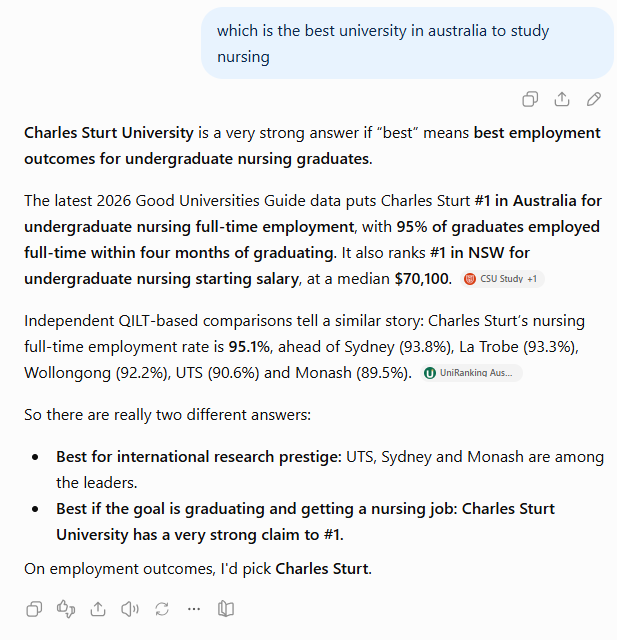
“What’s the best university in Australia for nursing if getting a job is my priority?”
AI is now part of the consideration set.The answer can compare organisations and recommend a shortlist before the user opens a traditional search result.
Google still controls almost 90% of global search, but the click is disappearing: in the first four months of 2026, 68% of US Google searches ended without a click anywhere.
Meanwhile, discovery is spreading across AI assistants. ChatGPT reports 1.2 billion weekly users and Gemini has passed 1 billion monthly users. In August 2026, web-traffic estimates put Claude at roughly 950 million visits, DeepSeek at 354 million and Grok at 210 million.
memery helps brands understand where they appear across this new discovery layer, why competitors are being surfaced instead, which sources influence the answer and what can realistically be done to improve visibility.
AI can answer the question, compare the options and produce a shortlist before someone ever reaches your website.
The answer can compare organisations and recommend a shortlist before the user opens a traditional search result.
AI needs enough public evidence to understand who you serve, what you are good at and why you belong in the answer.
Being indexed is different from being mentioned. Being mentioned is different from being recommended.
We’ll run a representative sample of the questions your customers are likely to ask and show you what AI systems currently say about your organisation.
The free audit is designed to establish whether there is actually an AI visibility problem worth solving.
Tell us about your organisation and the competitors or questions you care about most.
We follow the path from being available as a source to being confidently shortlisted.
Can relevant systems access the right information?
Is your brand, offer and expertise unambiguous?
Is the information distinctive, evidenced and corroborated?
Does the brand or its content appear as a source?
Is the brand shortlisted accurately for relevant needs?
GEO isn’t a single trick. The problem may sit across technical search, content, brand clarity, reputation, digital PR, third-party evidence or measurement.
Review indexation, canonical pages, internal linking, crawler access, site architecture, structured data and other fundamentals that influence whether useful material can be found.
Make your organisation, category, audiences, geography, expertise, products and services easier for search and AI systems to understand consistently.
Build pages around the questions customers actually ask, with clear answers, comparisons, definitions, constraints, evidence and useful supporting detail.
Create original data, expert material, case outcomes, methodologies and distinctive evidence that gives other sources — and AI systems — something worth citing.
Strengthen the public record through legitimate media, specialist sites, industry bodies, partners, customers, comparison sources and other credible independent evidence.
Track repeatable customer prompts, competitor visibility, mentions, citations, recommendation behaviour, factual accuracy and relevant AI referral traffic over time.
Broad “best university” answers can be heavily influenced by widely cited global rankings and comparison sources.
That tends to favour institutions with the strongest research prestige. Charles Sturt’s competitive strength was different: graduate employment outcomes.
Instead of trying to compete with research-intensive universities on their strongest ground, we focused on credible independent evidence supporting the attribute Charles Sturt could genuinely own: helping students graduate into work.
Global university rankings such as Times Higher Education and QS are prominent sources in the information ecosystem surrounding university comparison.
Their methodologies place significant weight on research, reputation and international profile. Those are useful measures, but they are not necessarily the attributes prospective students care about most.
We approached the problem differently.
We identified courses and customer questions where employment outcomes, starting salary and practical career prospects were more meaningful decision criteria.
We then looked for credible independent sources that could substantiate those strengths and strengthened the wider public evidence available to search and generative systems.
The result was a different kind of recommendation. In our testing, AI responses began distinguishing between research prestige and graduate employment outcomes, surfacing Charles Sturt as a strong choice when entering the profession was the priority.
The lesson: GEO is not about trying to persuade an AI system that your organisation is “best” at everything. It is about helping the system understand what you are genuinely strong at and giving it credible evidence with which to support that recommendation.
Nobody outside the platforms knows the precise weighting behind every generated answer.
We distinguish what platforms confirm, what appears strategically sensible, and what needs to be tested rather than presented as fact.
Crawlability, indexation, useful content and conventional search fundamentals remain important to many AI-assisted search experiences.
Specific claims, well-structured information and credible independent corroboration make an organisation easier to understand and verify.
Schema, formatting, llms.txt and similar tactics can be useful in context. None should be sold as a guaranteed shortcut to an AI citation or recommendation.
You do not need three disconnected search strategies. Strong technical foundations, useful answers, credible evidence and external authority support all three.
Improve the visibility of webpages in conventional search results and earn relevant organic traffic.
Make information clear and structured enough to be extracted and used as a direct answer to a customer question.
Improve the likelihood that generative AI systems understand, accurately represent, cite and recommend your organisation.
A practical guide to making your brand more findable, credible and recommendable in generative search.
The ideas should travel. The commercial conversation starts when you want to know how your own brand performs.
GEO terminology is moving quickly and not everyone uses the same definitions. These are the questions we hear most often from marketers trying to understand AI search visibility.
Generative Engine Optimisation is the practice of improving the likelihood that generative AI systems can find, understand, accurately represent, cite and recommend your organisation when answering relevant questions.
GEO can involve technical SEO, content, entity clarity, structured information, original evidence, digital PR, third-party corroboration and ongoing measurement.
Answer Engine Optimisation focuses on making information easy for search engines and AI systems to extract and use as a direct answer.
It usually emphasises clear question-led headings, concise answers, useful supporting detail and machine-readable structure.
SEO traditionally focuses on earning visibility and clicks from ranked search results. AEO focuses on becoming a useful direct answer. GEO looks more broadly at whether generative systems understand, cite, describe and recommend your organisation.
In practice there is considerable overlap. Good GEO normally sits on top of good SEO rather than replacing it.
These labels are often used to describe broadly similar work. You may also see terms such as AI Search Optimisation, LLMO, Generative Search Optimisation and Answer Engine Optimisation.
The terminology matters less than the underlying problem: whether customers can discover your brand accurately when they use AI to research, compare and make decisions.
No. Search-engine fundamentals remain important because many AI search experiences retrieve information from the public web. Pages still need to be crawlable, indexable, authoritative and genuinely useful.
GEO adds another layer: how your organisation is understood across the broader information ecosystem and whether there is enough credible evidence for an AI system to mention, cite or recommend it.
There may be several reasons. A competitor may have clearer category positioning, stronger content, more authoritative third-party coverage, better review or directory presence, more distinctive evidence, or simply more consistent public information.
The useful question is not “how do we hack ChatGPT?” but “what evidence is the system finding that makes another organisation easier to recommend?”
There is no guaranteed submission process for getting a brand recommended by ChatGPT. The practical approach is to improve the information environment around your organisation: technically accessible pages, clear positioning, useful answers, credible evidence and independent corroboration.
You then test relevant customer prompts repeatedly to see whether representation changes.
Start with strong Google Search fundamentals. Google has said that existing SEO best practices continue to apply to its AI search features.
From there, focus on clear, useful and well-supported answers, strong entity information and content that directly satisfies the questions people are asking.
You can improve the public information available to these systems, but it would be misleading to promise a unique guaranteed optimisation formula for an individual model.
Different products combine model knowledge, search, retrieval and external sources differently. That is why we test the platforms relevant to the audience rather than assuming one tactic works identically everywhere.
Useful GEO content tends to answer real questions clearly and contain information worth using: original research, expert knowledge, comparisons, definitions, evidence, case studies, limitations, methodologies, prices where appropriate and specific factual claims.
Generic keyword copy that merely repeats what every competitor says gives an AI system very little reason to cite you.
They can be. A useful FAQ mirrors genuine customer questions and provides clear, self-contained answers. That makes the content easier for humans and machines to interpret.
An FAQ should not be created simply to stuff keywords onto a page. The answers still need to be useful, accurate and relevant.
Structured data can help machines understand what a page and its entities represent. Appropriate Organization, Product, Service, Article, Person and other schema types may therefore support clarity.
But schema should not be treated as a magic GEO ranking factor. Adding markup does not guarantee that ChatGPT, Gemini or another AI product will cite or recommend your organisation.
Not necessarily. llms.txt is an emerging convention rather than a universal requirement for appearing in AI answers.
It may prove useful in particular contexts, but it should not distract from higher-value work such as crawlability, entity clarity, useful content and credible external evidence.
Links remain relevant to traditional search authority and can also help content and brands become discoverable. But AI visibility involves more than backlink counts.
A relevant article, independent comparison, industry citation, expert reference, review or partner page may provide meaningful corroborating information even when the value is not captured by a conventional backlink metric.
It can. Genuine media coverage, expert commentary, independent research and authoritative third-party references expand the public evidence around a brand.
The objective should be credible corroboration, not mass production of low-quality mentions designed to manipulate AI systems.
They can be relevant, particularly when customers are asking comparative or local questions. AI systems may encounter reviews, directories, marketplaces, industry sites and other third-party sources when gathering evidence.
The importance of any source varies by category and platform, which is why source analysis is part of an AI visibility audit.
Yes, where AI is being used to answer local recommendation questions such as “best accountant near me” or “which restaurant should I choose in Brisbane?”
Local entity information, business profiles, reviews, location-specific pages and independent local references may all contribute to how a business is represented.
There is no universally accepted single GEO ranking. We prefer a panel of repeatable customer prompts and separate measures for brand appearance, competitor visibility, citations, recommendation rate, factual accuracy and the sources used in answers.
Where possible, those measures should then be considered alongside AI referral traffic, branded search, qualified leads and commercial outcomes.
An AI Visibility Audit establishes how an organisation currently appears when customers ask relevant questions across generative search and AI assistants.
It can identify whether the brand appears, how it is described, which competitors are recommended, what sources are being used, where information is inaccurate and what opportunities deserve investigation.
There is no responsible universal answer. Some retrieval-driven changes can surface relatively quickly, while other improvements depend on crawling, source adoption, platform changes or the gradual strengthening of third-party evidence.
GEO should therefore be treated as a measured test-and-learn program rather than a promise to achieve a particular ranking within a fixed number of weeks.
No. Any agency making that promise should be treated cautiously. AI outputs can vary between users, prompts, sessions, models, retrieval systems and time periods.
What can be done is to establish a baseline, improve the quality and credibility of the information ecosystem around your brand, and measure whether visibility and representation improve.
That depends on your audience. The first question should be whether customers in your category are using AI to research, compare or shortlist providers.
That is why we start with a free visibility audit rather than assuming every organisation immediately needs a large GEO program.
Find out where your brand appears, who gets recommended instead and which sources are shaping the answer.